Why a Nessus Scan Is Not a Penetration Test
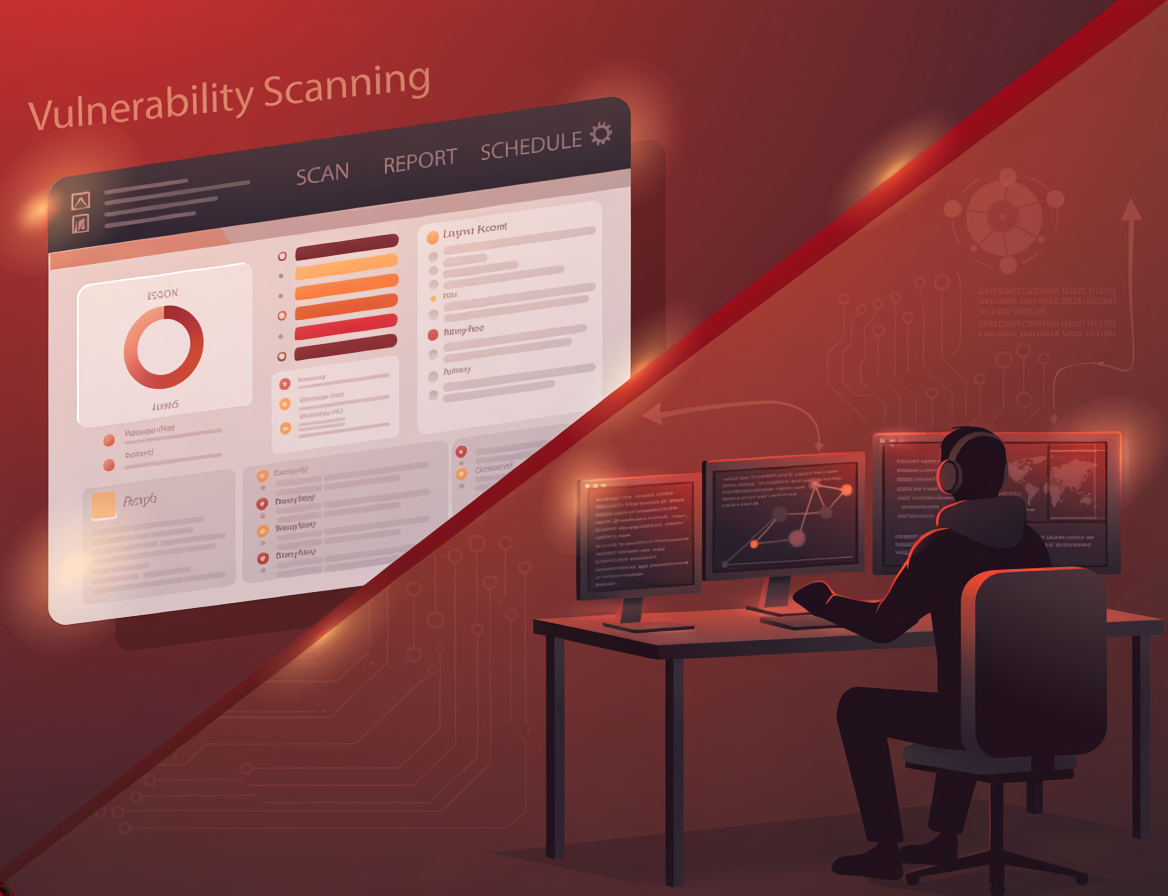
Many organizations rely on automated vulnerability scanners to regularly check their IT systems for security issues. Tools such as Nessus can identify known vulnerabilities and quickly produce a list of potential risks. However, such scans are often mistakenly considered equivalent to a full penetration test. In reality, these are fundamentally different security practices.
An automated vulnerability scan primarily checks systems for known signatures and documented vulnerabilities. The scanner compares detected software versions, configurations, and services against databases of known security issues. The result is a list of potential vulnerabilities that should be reviewed and addressed. While this automated analysis is useful and can be performed regularly, it does not replace a manual security assessment.
A penetration test goes significantly further. Experienced security professionals manually analyze systems and actively attempt to exploit vulnerabilities. This process considers not only known technical issues but also complex attack scenarios, misconfigurations, application logic flaws, and chains of multiple weaknesses. Pentesters also evaluate whether a vulnerability is realistically exploitable and what the potential impact of a successful attack would be.
Automated scanners cannot fully analyze authentication flows, understand business logic, or reliably determine whether a vulnerability can actually be exploited. As a result, scans often produce both false positives and missed vulnerabilities. A penetration test, in contrast, combines automated tools with manual analysis and practical attack simulations.
Vulnerability scanning and penetration testing should therefore be viewed as complementary rather than interchangeable. Automated scans are valuable for continuous monitoring and detecting known vulnerabilities, while penetration tests provide a deeper security assessment and demonstrate how a real attacker might compromise a system.
Organizations that want a realistic understanding of their security posture should not rely solely on automated scanners. A structured penetration test conducted by experienced security professionals is necessary to determine which vulnerabilities are truly exploitable and how significant the real-world risk is.
FAQ
Frequently Asked Questions
An ethical hacker is someone who attacks systems — with permission and with a clear goal: finding vulnerabilities before they are exploited.
Ethical hackers think like real attackers. They don’t look for theoretical issues, but for practical ways to actually break in, access data, or gain control. The difference to a criminal is not the technique, but the mandate.
At Hackeroo, this means: no show, no buzzword bingo. We test in a focused, responsible, and transparent way. Everything we find is documented clearly, assessed realistically, and explained so it can be fixed.
In short: ethical hackers break in so no one else can later.
A penetration test is a controlled attack on your IT systems with one clear goal: finding vulnerabilities before real attackers do.
We think and act like attackers. We don’t just scan the surface — we actively try to exploit security weaknesses in web applications, APIs, networks, cloud environments, and internal systems. We combine automated tooling with deep manual analysis, experience, and creativity.
The result is not a buzzword-filled report, but a clear answer to the most important question: How would someone actually break in — and how do you stop exactly that?
A penetration test exposes real risks, prioritizes them in a way that makes sense, and delivers concrete, actionable recommendations. No marketing. No checklists. Real security.
Red teaming is a realistic attack against your organization — not against a single system, but against the entire security concept.
Unlike classic penetration tests, red teaming does not follow a fixed scope or a checklist. The goal is to get as far as possible using real attacker tactics while staying undetected: technical attacks, abuse of processes, and bypassing controls. Exactly how real attackers would operate.
The focus is not on individual vulnerabilities, but on one key question: How well does your organization detect, prevent, and stop a real attack? Technology, people, and processes are tested together.
Red teaming delivers an honest, no-filter view of where security measures actually work — and where they only exist on paper.
The difference lies in how much information the pentester receives before the engagement starts.
Blackbox:
No prior information. The tester starts with almost no knowledge — similar to an external attacker.
This approach is realistic but inefficient, as significant time is spent on reconnaissance instead of structured vulnerability testing.
Learn more about Blackbox penetration testing.
Greybox:
The tester receives relevant information such as network ranges, subdomains, or test accounts.
This enables an efficient and structured assessment of the defined attack surface.
In practice, this is usually the most practical and cost-effective approach.
Learn more about Greybox penetration testing.
Whitebox:
Full transparency. Documentation, configurations, and often source code are provided.
This allows maximum technical depth but can become audit-like and is not always more efficient.
Learn more about Whitebox penetration testing.
Our recommendation:
In most cases, a well-prepared greybox penetration test offers the best balance between realism, depth, and efficiency.
Short answer: No. Hackeroo is a specialized B2B security provider. Our penetration tests and security assessments are designed exclusively for companies, startups, and organizations with real attack surfaces such as web applications, APIs, or internal networks.
Typical private requests (e.g., social media accounts, smartphones, or single devices) are outside the scope of professional security testing. Many of these requests also fall outside legal boundaries.Important notice:
Requests to hack social media accounts, private devices, or similar activities are strictly ignored and not answered.

